
 English
 简体中文
简体中文 French
 日本語
日本語 Korean
 Português
 Русский
 Spanish



NEWS
In the calcination production of lithium battery positive and negative electrode materials, kaolin, ceramic powder, metal oxides and other powders, common faults in high-temperature rotary furnaces are powder agglomeration and cylinder wall sticking. The adhesion of materials to the inner wall of the furnace drum can cause uneven heating, large differences in finished product particle size, severe agglomeration of discharged materials, and long-term accumulation can increase equipment cleaning costs and reduce yield. Most wall sticking problems do not require changes to the equipment structure, and can be greatly alleviated by adjusting the operating process parameters of the rotary furnace. Below, based on practical experience in mass production, we will explain 5 core parameter adjustment techniques to quickly solve the problem of powder agglomeration and wall sticking.
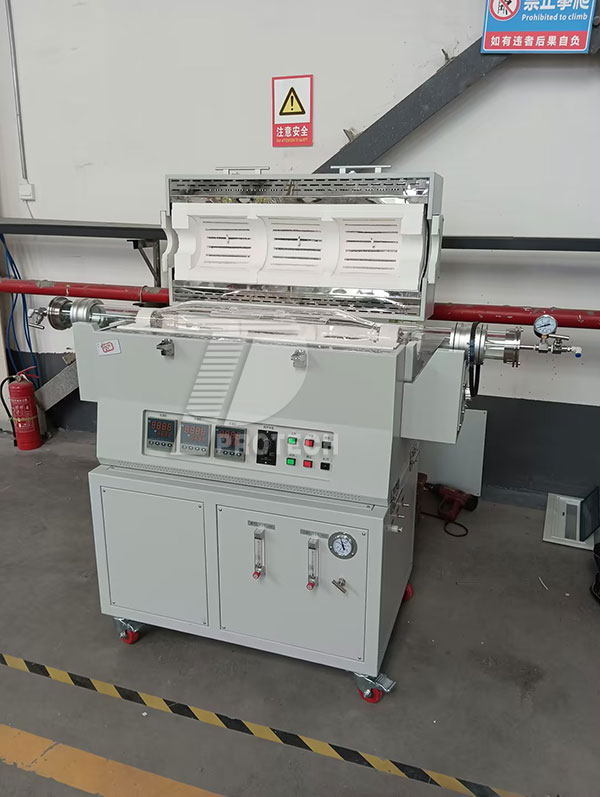
Customized large belly tube rotating tube furnace (click on the picture to view product details)
1. Reasonably lower the temperature of the constant temperature section of the furnace to reduce the tendency of material melting and adhesion
The primary cause of powder wall sticking is high sintering temperature, which leads to liquid phase softening on the surface of the material. Fine powder has a large specific surface area and is prone to form a micro melting layer at high temperatures. When it comes into contact with the furnace wall, it will adhere and accumulate, gradually forming a material circle.
Adjustment plan:
Reduce the maximum constant temperature by 30 ℃~80 ℃ while meeting the material sintering process standards;
Extend the heating range and adopt a stepped heating method to avoid the rapid precipitation of liquid phase from the powder when suddenly heated;
Slow down the cooling rate during the cooling stage to prevent sudden changes in material thermal stress and agglomeration.
Applicable scenarios: sintering and wall sticking of lithium battery materials, carbonates, and oxide powders.
2. Increase the rotational speed of the cylinder and shorten the residence time of the material on the inner wall
The rotational speed of the rotary furnace cylinder directly determines the duration of material adhesion on the furnace wall. The rotation speed is too slow, and the powder is left to adhere to the cylinder wall for a long time, causing the bonding to become thicker and thicker when heated; Moderate acceleration can allow materials to continue rolling and flipping, making them less likely to accumulate on walls.
Key points of practical adjustment:
Gradually increase the speed by 0.2~0.5r/min each time, and test step by step;
Considering sintering time: If the heating time of the material is insufficient after speeding up, the inclination angle of the furnace body can be adjusted to make up for the residence time;
Avoid excessive rotation speed causing severe material rolling and loss of fine powder dust.
3. Optimize the inclination angle of the furnace body and control the material travel rate
The inclination angle of the furnace determines the overall feeding speed of the powder, and both extremes of the inclination angle can induce wall sticking:
Too small inclination angle: The material moves too slowly and accumulates on the inner wall, repeatedly heated, and continues to clump and stick to the wall;
Excessive inclination angle: The powder flow rate is too fast, the heating is uneven, and local overburning produces viscous lumps.
Adjustment techniques:
The conventional powder calcination angle is controlled between 1.5 ° and 3 °; For materials with high viscosity, the inclination angle should be appropriately increased, while for lightweight ultrafine powders, the inclination angle should be slightly reduced to ensure that the material moves slowly and steadily, continuously rolling and updating the contact surface.
4. Regulating and protecting atmosphere pressure and airflow direction to reduce fine powder adhesion
Negative pressure and unreasonable atmosphere flow rate are also key factors for ultrafine powder wall adhesion. The negative pressure in the furnace is too high, and a large amount of ultrafine powder is carried by the airflow and adsorbed onto the top inner wall of the furnace drum; Turbulent airflow can cause powder to suspend and aggregate, and adhere to the cylinder wall after settling.
Parameter setting method:
Maintain a slightly positive pressure state in the furnace, prevent external air backflow, and reduce the ability of airflow to carry fine powder;
The carrier gas inlet is divided into sections for air distribution, and the airflow flows in the direction of material movement to reduce eddy currents;
Reduce the total flow rate of the atmosphere and avoid high-speed airflow blowing fine powder to adhere to the furnace wall.
5. Uniformly control the feeding amount to prevent material accumulation and overload
The feeding amount fluctuates, the feeding volume is too large, the powder layer in the furnace is too thick, the bottom layer of material is compressed, squeezed and bonded, and the upper layer of fine powder falls and adheres to the cylinder wall, which is prone to large-scale agglomeration.
Incoming control standards:
Adopting uniform and quantitative spiral feeding to maintain continuous and stable feeding, and eliminating intermittent and aggressive feeding;
It is better to reduce the single feed load and maintain the material filling rate in the furnace at 8% to 15%;
Easy to stick ultrafine powder can be mixed with a small amount of inert carrier powder to weaken the adhesion between particles.
Additional auxiliary suggestions
If there is still slight adhesion to the wall after adjusting the parameters, the cylinder wall can be periodically and briefly blown with high-temperature air, or a rotary furnace cylinder body coated with wear-resistant and high-temperature anti adhesion coating can be selected for dual protection to completely avoid powder adhesion problems.
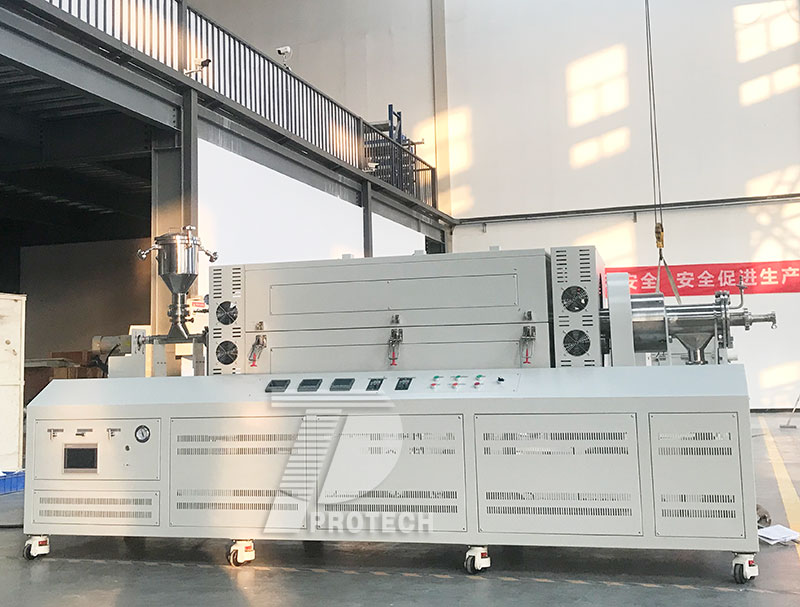
Customized multi zone rotary tube furnace (click on the image to view product details)
Summary
Powder agglomeration and wall sticking do not require blind maintenance and equipment modification. Parameters should be adjusted one by one in the order of sintering temperature → cylinder speed → furnace inclination angle → furnace atmosphere → uniform feeding. Most inorganic powders and new energy powders can effectively solve the problem of wall sticking and agglomeration during calcination, stabilize product quality, reduce equipment shutdown and cleaning frequency, and improve the overall production line operation efficiency.Click to learn more rotary tube furnaces! Or click on online customer service to learn more about product information!



Leave A Message


